Experimenting with Hermes Agent + DeepSeek-V4-Flash-0731 for ASP.NET Core and Nuxt

 +
+

I've been running Hermes Agent against DeepSeek-V4-Flash-0731 (API id deepseek-v4-flash) as a cheap loop for ASP.NET Core and Nuxt work. This is a lab note, not a recommendation to abandon whatever you already use.
My frontend teammates lean on Next.js and Claude Code. Fair, that stack pays for itself when the hard part is UI reasoning. Most of my days look different: minimal APIs, EF Core migrations, PostgreSQL, Nuxt pages, tests. Volume and consistency more than deep creative architecture. I've bounced between Codex CLI, and Cursor. Hermes + Flash-0731 is the combination I'm stress-testing right now because the agent loop is cheap enough that I don't flinch at long sessions, and when it stalls, I still hop to a stronger model for a turn.
Flash-0731 is DeepSeek's public-beta Flash checkpoint (re-post-trained for agent work). I'm on it because that's the beta I'm curious about, not because I've crowned a winner.
Cost note (why I'm willing to experiment)
Per DeepSeek's API pricing as of this write-up, deepseek-v4-flash is about $0.14 / $0.28 per 1M input/output tokens (cache hits much lower). In practice my Hermes days land roughly in the pocket-change range, far below a Max-style subscription or a heavy Opus API day.
I'm also watching DeepSeek's own agent-harness claims for Flash-0731. On their chart it lands ahead of GLM-5.2 and close to Claude Opus 4.8 on several agent-style benches, vendor-reported numbers, not my independent re-run, but enough signal that a cheap Flash tier is worth poking for coding-agent work:
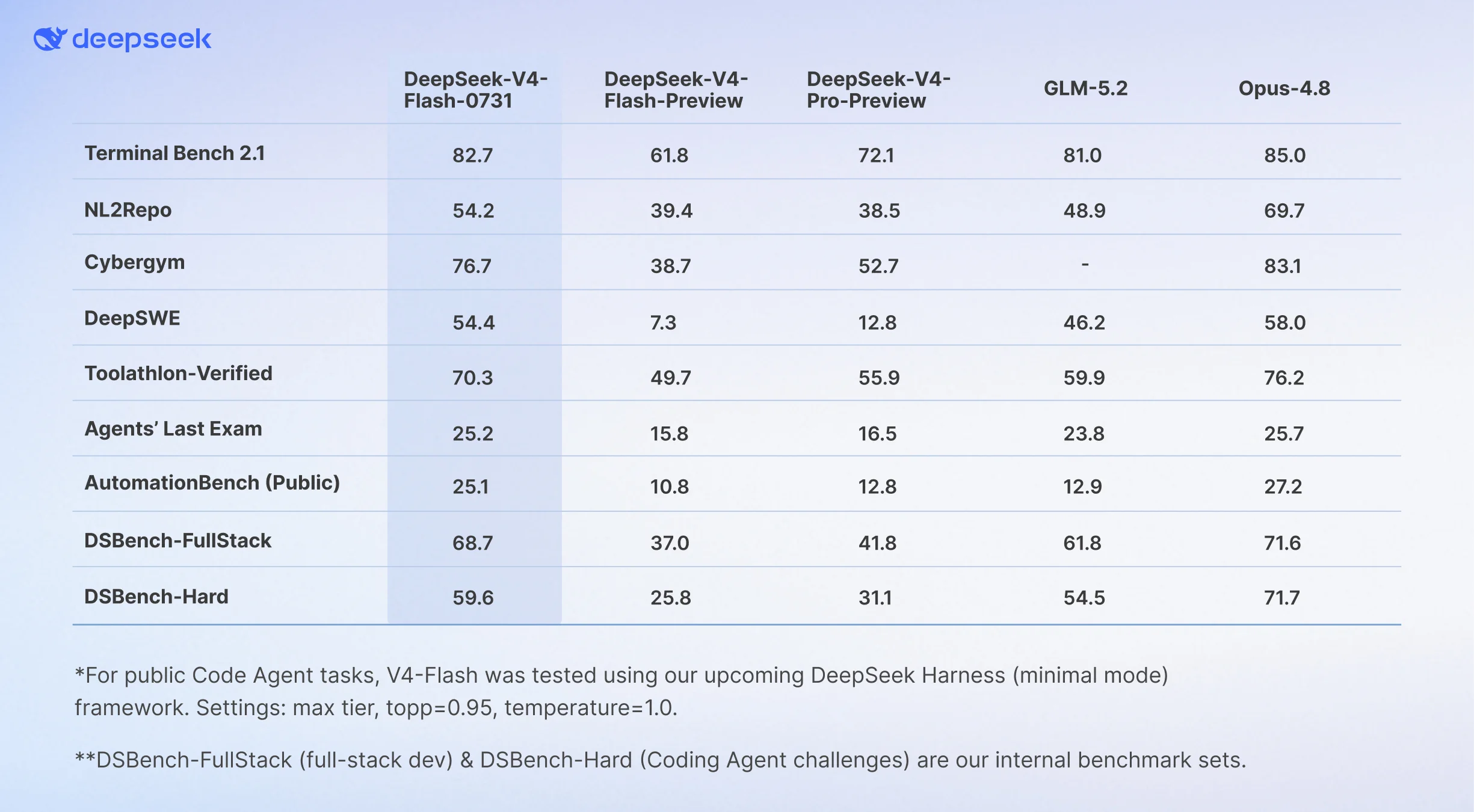
I'm not going to spreadsheet Claude vs Flash here. The interesting part for me is: can a cheap agent, taught my stack, do enough mechanical .NET and Nuxt work that the experiment is worth keeping?
So far: often yes for scaffolding and docs-aware UI. Still fuzzy on gnarly LINQ and auth-sensitive paths.
Setup I'm running
Install Hermes
Official docs: Hermes Agent Installation
Point it at Flash-0731
hermes model
Select / configure the DeepSeek provider and use model id deepseek-v4-flash (serves the V4-Flash-0731 checkpoint on the API).
Teaching Hermes the stack: skills + MCP
Out of the box, the model doesn't know my folder layout, Nuxt UI v4 quirks, or how I want commits and PRs written. Two layers fix that:
- Skills: project conventions (APIs, git/PR style)
- MCP: live docs and tools (Nuxt/Nuxt UI docs, git + GitHub actions)
Skills for .NET
Skills are structured SKILL.md files (open skill format). Hermes keeps a light index and only pulls full rules when a skill is invoked, which helps with token burn.
I start with dotnet/skills, then teach project-specific patterns with /learn.
> /learn the project structure and architectural patterns in ./src/backend/MyProject.Api, focus on feature slices and request pipeline
Example of the kind of skill Hermes distills (trimmed):
---
name: aspnetcore-minimal-api
description: Build ASP.NET Core Web APIs with feature-folder modules.
version: 0.1.0
author: Hermes
metadata:
  hermes:
    tags: [AspNetCore, MinimalApi, EfCore, PostgreSQL, ProjectTemplate]
---

### Feature Module Layout

Each module has three subfolders under a namespace folder:

```
<Module>/
  Apis/<Feature>Api.cs
  Models/<Entity>.cs
  Services/<Feature>Service.cs
```

**Minimal API pattern** — static class + extension method on `IEndpointRouteBuilder`:

```csharp
public static class SomeFeatureApi
{
    public static IEndpointConventionBuilder MapSomeFeatureApi(this IEndpointRouteBuilder endpoints)
    {
        var group = endpoints.MapGroup("/someFeature").WithTags("SomeFeature");

        group.MapGet("/{id}", GetItem)
            .WithName("GetItem")
            .RequireAuthorization("SomeFeature.View");

        return group;
    }

    private static async Task<Results<Ok<ItemResponse>, NotFound>> GetItem(
        long id, AppDbContext db) { /* ... */ }
}
```
After that, prompts like "add a feature slice for invoices" land closer to the house style instead of generic controller soup.
Skills for git / PRs
I want the agent to ship the boring git loop without inventing commit noise. A git skill covers house rules: short why-focused commit messages, Co-authored-by lines when Hermes wrote most of the diff, PR title/body shape (summary + test plan), no force-push to main, don't commit secrets.
That way "commit this and open a PR" produces something I'd actually submit, not a wall of AI filler.
Nuxt + Nuxt UI MCPs (live docs)
Skills teach my conventions. MCP teaches current framework docs. Hermes needs --url, --command, or --preset on mcp add (docs). For the hosted Nuxt docs servers:
hermes mcp add nuxt --url "https://nuxt.com/mcp"
hermes mcp add nuxtui --url "https://ui.nuxt.com/mcp"
Then hermes mcp test nuxt / hermes mcp test nuxtui (or /reload-mcp in a session).
With those connected, asking "how do I use UBadge with an icon in Nuxt UI v4?" can pull real component metadata instead of a confident wrong API. Same for Nuxt routing, content, and module docs.
Day-to-day difference I've noticed: without MCP, Flash will happily invent prop names. With MCP, the UI glue is boring in a good way, which is what I want from a cheap agent.
Git + GitHub MCPs (stage → commit → push → PR)
Docs MCP is only half the loop. I also connect git and GitHub MCPs so Hermes can actually move the work. Local git via uvx, GitHub via the official stdio server (set GITHUB_PERSONAL_ACCESS_TOKEN in the server env / Hermes config):
hermes mcp add git --command uvx --args mcp-server-git --repository /absolute/path/to/repo
hermes mcp add github --command npx --args -y @modelcontextprotocol/server-github
With those plus the git skill, a typical close-out looks like: stage the right files → commit with a sane message (and co-author trailer when appropriate) → push the branch → open a PR with a usable description. I'm still babysitting auth and anything destructive, but the mechanical GitHub dance is what I'm trying to automate.
What's next in the experiment
Working well enough to keep: Hermes + deepseek-v4-flash, dotnet + Nuxt + git skills, Nuxt/Nuxt UI MCP for component truth, git/GitHub MCP for the commit→PR path.
Still fuzzy: how far I can push Flash-0731 before I should route hard turns automatically; how much skill surface area is worth maintaining by hand vs regenerating with /learn; how much of the GitHub loop I trust without a human glance.
If the beta shifts or Pro's official drop lands, I'll note what changes. For now this is the setup on my machine, cheap, opinionated, and unfinished on purpose.
What 5 Years with Django Taught Me: Pros and Cons
After half a decade of building apps with Django, here's my honest take on its strengths, weaknesses, and the lessons I've learned along the way.
AuthEndpoints 3.0 RC: a composable auth endpoints library for ASP.NET Core
Announcing AuthEndpoints 3.0 RC, an auth library for ASP.NET Core. Composable auth endpoints on top of ASP.NET Core Identity: registration, login, 2FA, password reset, and passkeys bootstrapped in minutes.